
When a home or business feels overwhelming—whether due to accumulated grime, a recent renovation, or a distressing event like water damage—the first instinct is often to call a cleaning service. However, not all "messes" are created equal.
One of the most common points of confusion in the cleaning industry is the difference between deep cleaning and remediation. Homeowners and property managers frequently request a "deep clean" when, in reality, the property requires safety-focused remediation first. Conversely, some assume that once a remediation crew removes a hazard, the home is ready to live in—only to find it dusty and unfinished.
In this guide, we will clarify exactly what these terms mean, why the distinction matters for your safety and wallet, and why the most successful restorations often require both steps in a specific order.
If you are unsure whether your property needs a restorative scrub or a safety intervention, understanding the difference between regular cleaning vs. deep cleaning is a great place to start. But if you are dealing with distinct hazards like mold, pests, or sewage, read on to ensure you book the right service.
Ready to get started on restoring your space? You can always request a free estimate to discuss your specific needs.
What Deep Cleaning Actually Means (and What It Doesn’t)
Deep cleaning is best understood as restorative cleaning. It is a comprehensive, top-to-bottom detailing process designed to bring a home back to a baseline of "immaculate." While maintenance cleaning handles the surface dust and day-to-day tidying, deep cleaning attacks the buildup that accumulates over months or years.
The Definition of Professional Deep Cleaning
When you hire a team for deep residential cleaning, you are paying for the removal of ingrained dirt, grease, scale, and dust that standard cleaning misses. It is about hygiene and aesthetics.
A professional deep clean typically includes:
- Kitchens: Heavy degreasing of cabinet fronts, deep scrubbing of appliances (inside ovens and fridges), and detailing corners and edges where crumbs and oils collect.
- Bathrooms: Intensive descaling of shower glass, scrubbing grout lines, removing soap scum buildup, and disinfecting all sanitary surfaces.
- General Living Areas: Washing baseboards, door frames, window sills, and tracks; vacuuming upholstery; and cleaning under movable furniture.
- Air Quality: Dusting vents, returns, and ceiling fans to reduce allergens.
To see exactly how a professional team tackles these areas, you can review our deep cleaning process.
What Deep Cleaning Is Not
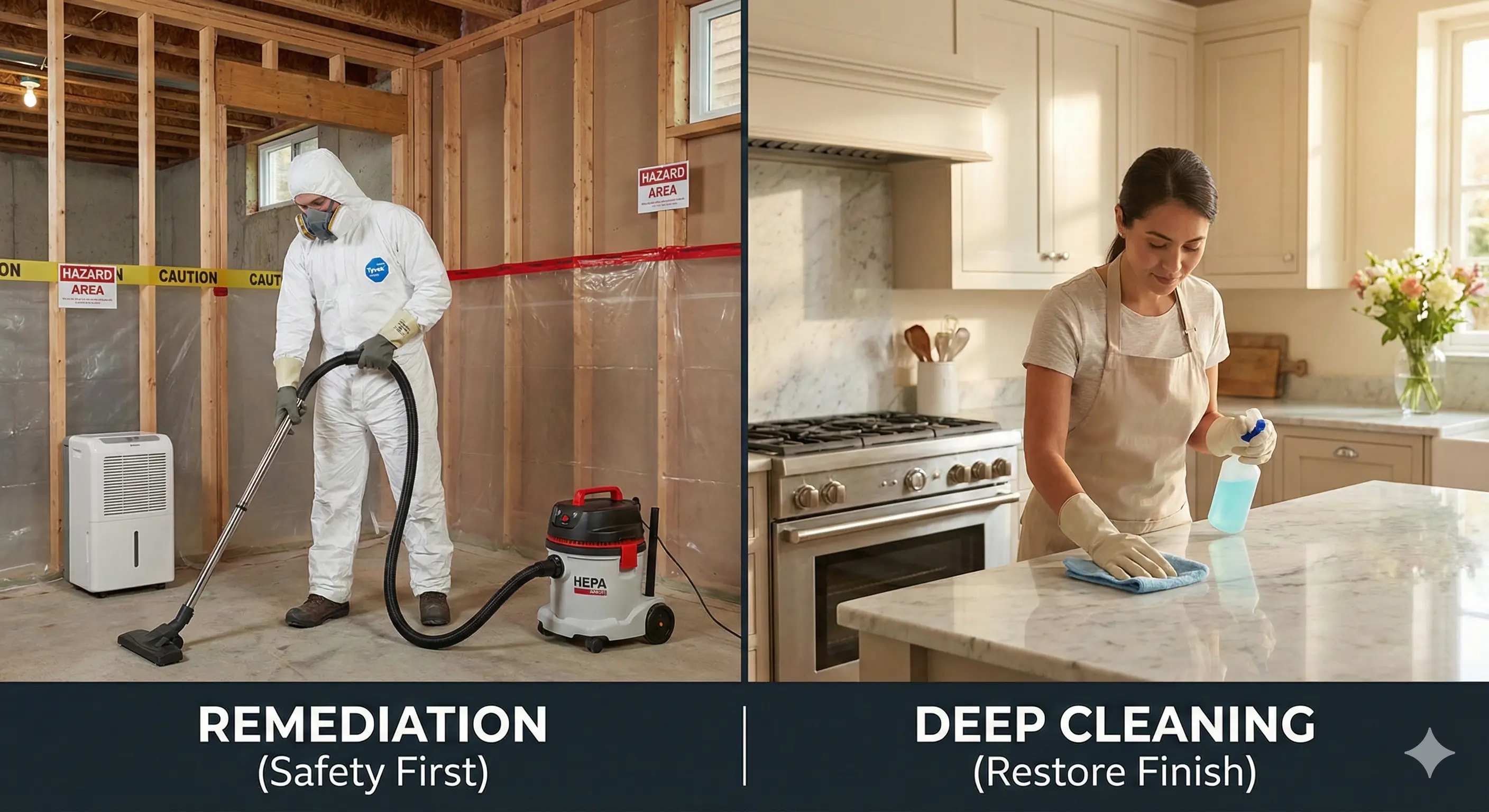
Despite its thoroughness, deep cleaning has limits. It is not a solution for hazardous materials. A deep cleaning crew is equipped with vacuums, scrubbers, and high-quality detergents, but they are generally not equipped with full-body HAZMAT suits or negative air pressure machines.
Deep cleaning is not:
- Mold abatement (killing surface mold is different from removing a mold infestation).
- Biohazard or crime scene cleanup.
- Sewage extraction.
- Pest extermination.
If your home requires the removal of biological hazards, you need to contact us for a quick assessment so we can determine if a remediation specialist is required before the cleaning team arrives.
What Remediation Means (and Why It’s a Different Category of Work)
If deep cleaning is about cleanliness, remediation is about safety.
Remediation refers to the controlled removal and containment of hazardous contaminants. The goal of remediation is not necessarily to make the house look pretty; it is to stop a dangerous situation from getting worse and to remove threats to human health.
The Remediation Focus: Hazard Removal
Remediation is required when the "dirt" in a home is actually a biohazard. High-level examples include:
- Mold: Caused by moisture intrusion, requiring containment to prevent spores from spreading to the HVAC system.
- Insects and Infestations: This involves the removal of heavy cockroach activity, bed bugs, or other pests that leave behind allergenic droppings and carcasses.
- Rodents: Rats, mice, or raccoons in an attic or basement create significant health risks through urine, feces, and nesting materials.
- Sewage: Backups from toilets or drains (blackwater) contain pathogens that cannot simply be "wiped up."
If you suspect any of these issues, please talk to us about your situation immediately. We can help triage the problem.
Why It’s Different from Cleaning
The primary difference lies in the protocols used. Remediation professionals use specialized containment barriers (plastic sheeting), air scrubbers (HEPA filtration), and Personal Protective Equipment (PPE) like respirators.
Their job is to remove the source of the danger. This often involves:
- Cutting out drywall that has mold.
- Removing insulation contaminated by raccoon urine.
- Pulling up carpets soaked in sewage.
Because this work is invasive, it requires a strict inspection and scope of work. You can learn more about how our process works regarding assessments and inspections.
The Golden Rule: Remediation puts safety first; deep cleaning handles the cleanliness and finish after the safety work is done. If you are dealing with a potential hazard, get a professional assessment before booking a standard cleaner.
When You Need Deep Cleaning: The High-Intent Scenarios
Most homeowners will need a deep clean at various transition points in their lives. These are scenarios where "good enough" isn't acceptable, and a full restorative clean is necessary.
A) Move-In Deep Cleaning
Moving into a new home is exciting, but discovering the previous owner’s hair in the bathroom drawers or grease on the kitchen cabinets can ruin the experience. A move-in deep clean resets the hygiene of the home to zero. It ensures that the space is safe, smells fresh, and is truly yours.
If you have just picked up the keys, schedule a move-in deep clean to ensure your first night in the new home is comfortable.
B) Move-Out Cleaning (Preparing a Listing)
Whether you are a tenant trying to get a security deposit back or a homeowner preparing for real estate photos, the standard for move-out cleaning is high. Buyers and landlords inspect baseboards, inside ovens, and window tracks.
For sellers, a sparkling home can increase the perceived value of the property. Learn more about the specific requirements of move-out cleaning for home sellers. When you are ready to list, request a free estimate to get the property show-ready.
C) Once-a-Year Spring Cleaning
Over the course of a year, dust settles in places regular vacuuming doesn't reach—like behind radiators, on top of door frames, and inside light fixtures. An annual deep clean reduces allergens and preserves the finishes of your home.
This is the classic example of deep cleaning vs. regular cleaning; regular cleaning maintains the status quo, while the annual deep clean resets the baseline.
D) Post-Renovation / Post-Construction Cleaning
This is one of the most technical types of cleaning. Construction creates a fine, insidious dust (silica and drywall dust) that coats walls, settles into vents, and creates a haze on floors.
A standard cleaner cannot handle post-reno dust; it requires HEPA vacuums and specialized damp-wiping techniques to prevent the dust from simply resettling. If you’ve just finished a project, you need a dedicated post-renovation cleaning service.
For a detailed look at how we tackle construction residue, read our guide on the post-renovation deep cleaning process.
(We proudly serve the Golden Horseshoe area. If you are finishing a renovation locally, check out our deep residential cleaning in Oakville or deep residential cleaning in Toronto).
When You Need Remediation: Red Flags You Should Not Ignore
There are specific signs that indicate you need to stop, assess, and call a remediation expert rather than a cleaner. Attempting to clean these hazards yourself—or hiring a general house cleaner to do it—can spread contamination and cause serious health issues.
If you see these red flags, contact us for next steps immediately so we can guide you to the right solution.
1. Visible Mold or Persistent Musty Odors
A small spot of mildew on bathroom caulking is a cleaning issue. However, fuzzy growth on drywall, baseboards, or ceilings—accompanied by a strong, earthy smell—indicates an active colony. Scrubbing this releases spores into the air, contaminating the rest of the house.
- Action: Get an assessment to identify the moisture source and extent of growth.
2. Rodent Activity (Droppings, Urine, Nesting)
Rodent infestations are not just messy; they are dangerous. Hantavirus and other pathogens can be transmitted through breathing in dust contaminated with rodent urine or droppings. Vacuuming up mouse droppings without proper disinfection and HEPA filtration can aerosolize these viruses.
- Action: If you find piles of droppings or chewed insulation, request a walkthrough to discuss safe removal.
3. Insect Infestations
Heavy infestations of cockroaches or bed bugs require extermination and specialized cleanup. The "mess" left behind (carcasses, frass/droppings) is a potent allergen that can trigger asthma attacks.
- Action: Do not try to sweep this up yourself. Contact our team for advice.
4. Sewage Backup
If a toilet overflows with "blackwater" or a drain backs up into the basement, this is a biohazard. This water contains bacteria, viruses, and parasites. Porous materials (drywall, carpet, wood) touched by sewage often need to be removed, not just cleaned.
- Action: Speak with us before cleaning to ensure you don't accidentally spread bacteria through your home.
Why You Still Need Deep Cleaning After Remediation
A common misconception is that once the remediation crew leaves, the house is ready for dinner guests. This is rarely the case.
Remediation makes the area safe, but it often leaves the area messy. Remediation crews focus on demolition, containment, and hazard removal. Their "clean" is a safety standard, not a white-glove standard.
The "Gap" Between Safe and Clean
After a remediation project (like mold removal or asbestos abatement), you are often left with:
- Settled Dust: Demolition creates dust, even with containment.
- Residue: Disinfectants or encapsulants used on structural wood can leave smells or residues.
- Disrupted Surfaces: The areas surrounding the work zone often get neglected during the intense safety work.
The Role of Post-Remediation Deep Cleaning
Once the remediation team signs off and the air quality test passes, a deep residential cleaning team should come in to bridge the gap.
This phase includes:
- HEPA Vacuuming: Cleaning all vertical and horizontal surfaces to remove any remaining fine particulate.
- Detailed Wiping: Cleaning walls, shelves, light fixtures, and windows that may have been covered in plastic or exposed to dust.
- Sanitization: Ensuring the high-touch surfaces in the rest of the home are hygienic.
We highly recommend you see what deep cleaning includes to understand how we turn a "safe" construction zone back into a cozy home.
If your remediation project is nearing completion, book a deep cleaning quote now to ensure a seamless transition.
Deep Cleaning vs. Remediation: Quick Comparison
Here is the simplest way to visualize the difference. If you want a more detailed breakdown of cleaning tiers, check out our guide on regular cleaning vs. deep cleaning.
The Typical Sequence:
In a disaster scenario, the order of operations is vital:
- Inspection: contact us for a scope review.
- Remediation: Remove the hazard.
- Deep Cleaning: Remove the residue and restore the finish.
You can learn more about how we structure these projects on our process page.
Cost and Quoting: Why Scope Matters
Just as the work differs, so does the pricing. Deep cleaning is generally priced based on the size of the home and the level of detail required, whereas remediation is priced based on the severity of the contamination and the complexity of containment.
Understanding the Cost
- Deep Cleaning: Pricing is influenced by square footage, the number of bathrooms, the presence of pets, and how long it has been since the last professional clean. For a deeper dive, read why deep cleaning costs what it costs.
- Remediation: Pricing involves lab fees (for testing), equipment rental (dehumidifiers/scrubbers), and disposal fees for hazardous waste.
We cannot give an accurate price over the phone for complex restorative work because every home is unique. That is why we emphasize on-site consultations.
To understand the factors influencing your specific project, check out our deep cleaning pricing factors or simply contact us for guidance.
Ready to get a number? Get a free estimate today.
Choosing the Right Provider (and Avoiding Disappointment)
Hiring the wrong company can lead to wasted money or, worse, safety risks. You wouldn't hire a maid service to remove asbestos, and you wouldn't hire a demolition crew to polish your granite countertops.
We have compiled a guide on how to choose the best deep cleaning company, but here are the basics.
Questions to Ask Before Booking
- "Do you do a walkthrough?" A reputable company will want to see the space to give an accurate quote.
- "What is your scope for hazardous materials?" Honest cleaners will tell you what they cannot touch (e.g., "We don't clean active black mold").
- "What equipment do you use?" Look for HEPA vacuums and colour-coded microfiber cloths to prevent cross-contamination.
If you are unsure what "good" looks like, reviewing our process will give you a benchmark for professional standards. If you have specific concerns, contact us directly to ask these questions.
Related Services That Often Pair With Deep Cleaning
When you are investing in a deep clean—especially after a move-out or renovation—it is often efficient to bundle other services.
Carpet and Upholstery Cleaning
Carpets act as filters, trapping dust, odors, and allergens. A deep clean handles the hard surfaces, but carpet cleaning handles the soft ones. This is critical for pet owners or move-in scenarios.
- Learn about the carpet and upholstery cleaning process.
- Book professional carpet cleaning alongside your deep clean.
deep office cleaning
Businesses face the same issues as homeowners. An office that has suffered a leak or long-term neglect needs the same "Remediation + Deep Clean" approach.
- We offer specialized deep office cleaning services.
- Read more about commercial carpet cleaning for offices to maintain a professional appearance.
Conclusion: The Right Service in the Right Order
Maintaining a healthy property requires recognizing what kind of "mess" you are dealing with.
If it is grime, dust, grease, or general neglect, you need a Deep Clean.
If it is mold, sewage, pests, or biohazards, you need Remediation.
And if you have just finished remediation, you almost certainly need a Deep Clean to make the home livable again.
Don't let the confusion lead to a poor result. Whether you need a simple reset or a complex post-disaster clean, we are here to help you navigate the process.
Ready to restore your home?
- request a free estimate for your deep cleaning project.
- Contact our team if you are unsure if you need remediation first.
- See all cleaning services to find the right fit for your needs.
Not sure whether you need deep cleaning or remediation first? Share a few details and we’ll recommend the right sequence. Start here: Request a free estimate.
Request a quote