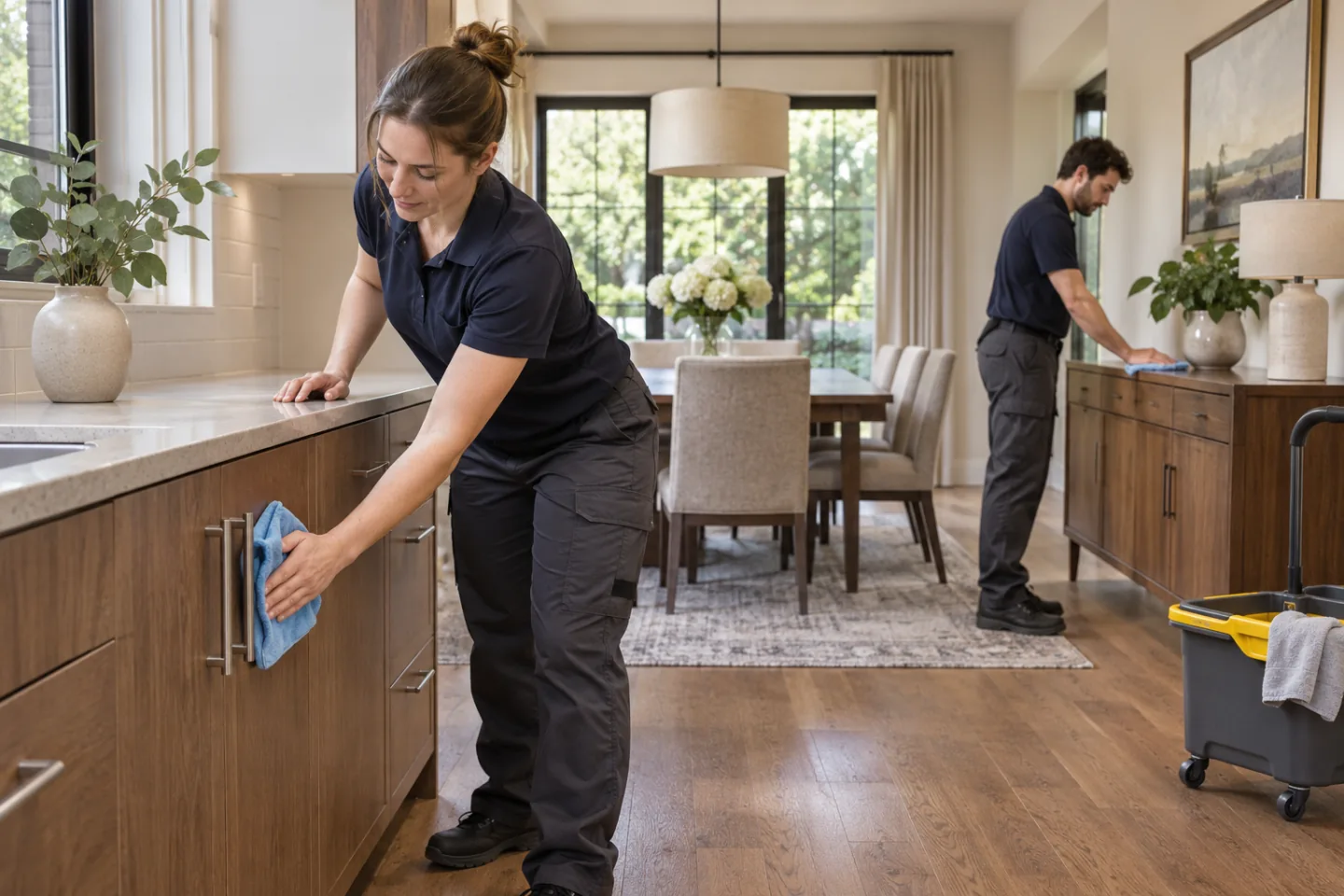
First, ask what “eight hours” means.
One cleaner working for eight hours and four cleaners working for eight hours are very different bookings. The first provides eight labour hours. The second provides 32 labour hours across the team, during an eight-hour visit.
Ask whether a quoted number refers to one person, the whole team or the appointment window. Also confirm whether setup and the final review are included. This prevents a reasonable-looking number from becoming an unexpected scheduling problem.
Does doubling the team halve the visit?
Not reliably. Separate rooms can be cleaned at the same time, but some tasks have to happen in order. Loose grit needs collecting before the final floor wash. A cleaning product may need time to work. A narrow bathroom cannot always accommodate another cleaner.
For example, another cleaner can take responsibility for a bedroom while someone works on the kitchen. That does not shorten the time a kitchen treatment needs to work, or let the final floor pass happen before the dusty work above it. Team planning needs to account for both tasks that can run together and tasks that must wait.
Why can a regularly cleaned home still need substantial deep-cleaning work?
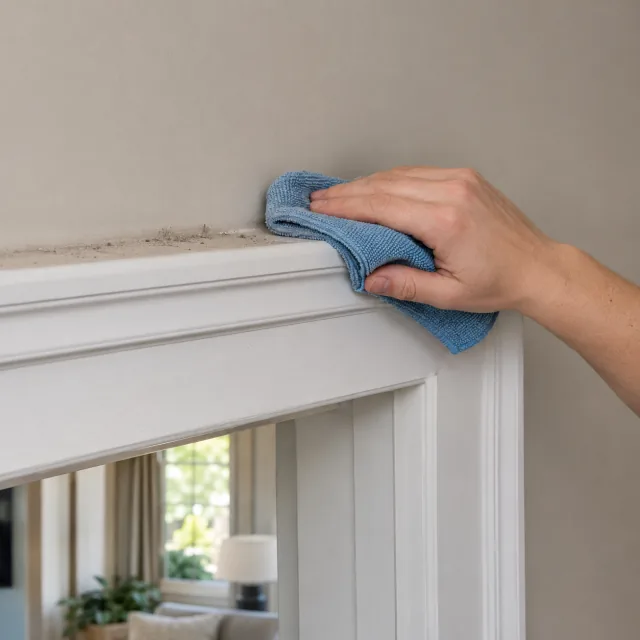
Regular cleaning, done properly with a method suited to each surface, keeps the rooms you use every day comfortable. How often a home is cleaned is only part of the picture; the result matters too. Deep cleaning also addresses places that are cleaned less often: the top of a door, the edges around cabinet handles, the corners of an empty drawer and the channels inside a window track.
A home does not need to look neglected for those tasks to add up. The difference is the amount of surface being worked on and the treatment it needs. A floor that looks clean tells us little about the grease on the cabinet tops or the condition inside the cupboards.
Regularly mopped does not always mean free of buildup.
Even the floor itself may need a closer look. Soil can remain in the recesses of embossed or textured flooring, so another broad mop pass may not address it. Shaw’s care guidance for textured resilient flooring describes this as a separate cleaning concern. The right method depends on the actual flooring and its care instructions.
Cleaner residue is another possibility. Too much cleaner or an unsuitable product can leave a film; repeating the same routine may add to the buildup instead of removing it. Bona’s guidance on cloudy wood floors identifies cleaner buildup as one possible cause, alongside other causes that need a different response. Follow the product’s dilution and residue-removal instructions rather than assuming more detergent means a cleaner floor.
Very dark, even “coffee-coloured”, water during deeper cleaning can be striking. Its colour alone does not identify what was removed or prove that earlier maintenance was poor. The useful assessment is of the surface and the result once dry: is removable soil or film still present, and can it be treated without harming the finish?
What this means for timing: a floor that needs residue assessment and treatment is a different task from a routine mop. Show any persistent haze, sticky area or soil in the texture before the team and finish time are confirmed. Areas already maintained to the required standard may need less work.
| The room looks clean because… | The deeper task may be… | Where the time goes |
|---|---|---|
| The floors are vacuumed and mopped regularly. | Cleaning baseboard tops, corners, door thresholds and reachable edges beside furniture. | Working along the room perimeter and reaching details that a broad floor pass misses. |
| Kitchen counters are wiped every day. | Removing grease around handles, cabinet profiles and accessible upper edges. | Identifying the finish, testing a compatible degreaser, allowing its specified working time, removing soil and cleaning away product residue. |
| Cupboard doors look tidy. | Cleaning empty shelf surfaces, interior corners, drawer edges and the inside faces of doors. | Working inside each agreed opening rather than wiping only its front. |
| Window glass is clear. | Collecting grit from accessible tracks and cleaning frames, sills and corners. | Several small surfaces and channels per window, with careful moisture control. |
| Bathroom fixtures are regularly wiped. | Treating mineral buildup around a tap base or shower fitting where the finish allows it. | Checking compatibility, treating the deposit and reviewing the result without scratching the fitting. |
| The bedroom is dusted weekly. | Cleaning reachable door tops, trim, high ledges and agreed wall areas. | Access, additional surface area and a method suitable for the paint or other finish. |
A useful five-minute check before asking for a quote: look at an accessible door-frame top, one kitchen handle and its edges, one window track, a tap base and the inside corner of a cupboard you want cleaned. Photograph the actual buildup. Do not climb or pull out appliances to do this.
If those areas need attention across many rooms, the workload can be substantial even though the home is otherwise well cared for. Conversely, areas already maintained to the required standard may need less work. We assess what is there rather than treating “deep clean” as the same number of hours for every property.
Three extensive cleaning projects—and what they meant for the visit.
These are extensive projects our team completed. They are individual examples, not typical durations or a timetable for a similar-sized home.
On a small screen, scroll sideways to read every column.
| Project | Cleaners | Time on site | Combined labour hours |
|---|---|---|---|
| 650 sq. ft. empty apartment | 4 | 12 hours | 48 |
| 1,800 sq. ft. Toronto move-in apartment | 4 | 8 hours | 32 |
| About 1,000 sq. ft. Markham post-renovation apartment | 5 | 9 hours | 45 |
The smallest apartment took the longest.
The 650 sq. ft. apartment needed wall washing for children’s drawings, floor washing, kitchen-exterior degreasing, fridge cleaning, and windows and tracks after a long period without thorough care. Being empty improved access; it did not remove the buildup. Planning point: do not use “empty apartment” as a reason to shorten the visit before the actual detailing work is assessed.
The Toronto move-in project needed a full team day.
The 1,800 sq. ft. apartment had very tall ceilings. Its agreed work included accessible surfaces, walls and floors, cabinetry exteriors, oven and stove, microwave, cupboard interiors and faucet descaling. Planning point: confirm those additional interiors and treatments before setting the move-in schedule. They were included in this project, not automatically in every deep-cleaning booking.
The Markham apartment did not look heavily dusty.
The approximately 1,000 sq. ft. apartment needed extensive post-renovation work on ceilings, walls, floors and windows despite looking fairly tidy. Planning point: show the surfaces and window details during the assessment, rather than relying on the view from the doorway when estimating the time.
Use these examples to identify work worth discussing. Use your own agreed task list and team plan to schedule the visit.
What changes how long a deep clean takes?
| Detail | Why it affects the visit | What to tell us |
|---|---|---|
| Grease, scale and stubborn marks | They need assessment and suitable treatment, rather than the same wipe used for loose dust. | Show the affected area close up and identify the surface if you know it. |
| Walls and high ceilings | Surface area, finish and safe access add work that floor area does not capture. | State which walls need washing and show tall or hard-to-reach areas. |
| Cupboard and appliance interiors | Empty shelves, corners and interior components add separate tasks. | List each interior you want included and whether it will be empty. |
| Window components | Glass, frames, sills and tracks are different jobs. | Name the parts and whether exterior access is required. |
| Furniture and belongings | Blocked surfaces can prevent work or require a different access plan. | Explain what stays, what will be cleared and what must not be moved. |
| Recent renovation | Remaining trade work and new finishes can change the sequence or prevent washing. | List return visits and provide the installer’s care instructions. |
| Building access | Parking, keys and lift bookings affect when equipment and people can reach the home. | Share entry rules and any restricted working hours. |
“Relatively clean” is useful context, but it is not a task list. A clear photo of greasy cabinet fronts or marked walls helps more than a general cleanliness rating. Our photo guide for a deep-cleaning quote shows what to send.
Careful treatment can take longer than harder scrubbing.
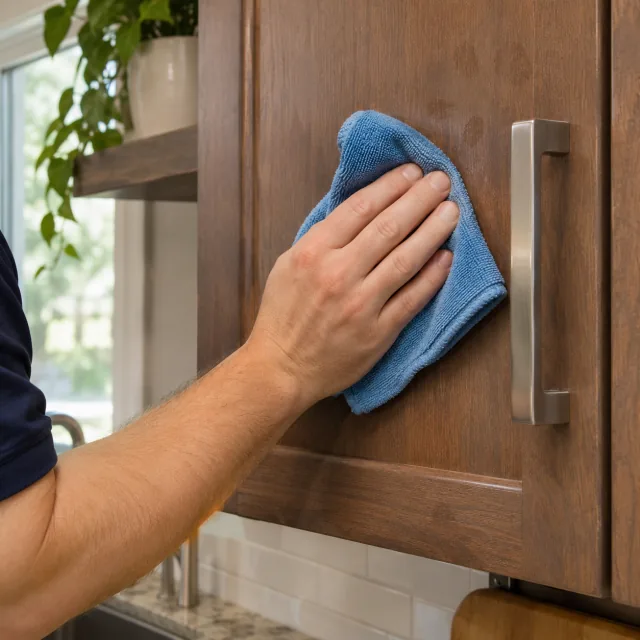
Take a greasy cabinet front. A quick wipe may remove loose dust while leaving the sticky film behind. Detailed work means checking the coating, testing a suitable degreaser, using the label’s dilution and working time, lifting the softened soil, then removing product residue as directed. A clean cloth face is needed as the soil comes off. Scrubbing harder with an abrasive pad can damage the finish instead of saving time.
A hazy wood floor is another example. After loose dust is collected, the remaining film may need a treatment suited to the floor’s finish and a small test area. The result must be checked once dry: a wet floor can temporarily hide haze. That takes longer than ordinary mopping, and some finish defects need a flooring specialist rather than more cleaning.
For the broader difference between routine upkeep and this work, see what deep cleaning includes.
How we turn square footage and extra tasks into a team plan.
At Let’s Get It Clean, we use a per-cleaner square-footage allocation to plan the base workload. We then check that allocation against the property’s condition, surface materials, heights and access. Floor area is a starting point for staffing, not a complete description of the work.
Separately priced tasks receive an additional workforce allocation. Cupboard and appliance interiors, additional window work or an agreed residue treatment are assigned workforce beyond the base area allocation. We identify who will handle those tasks and fit them into the team’s sequence before confirming the visit plan.
- Define the area. Record the square footage to be cleaned, rooms, bathrooms and any excluded areas. Tell us whether the home is empty or furnished.
- Count the detailed work. List windows and their components, cupboard and drawer interiors, and each appliance interior. “Kitchen included” is not specific enough to plan those tasks.
- Inspect the slow areas. Show grease, scale, wall marks, construction residue and floor haze. Record the affected material and extent—one door front is different from every cabinet.
- Allocate the base work and extras. Assign the square-footage workload to cleaners, then assign additional workforce to the separately priced tasks. Check what can happen in parallel and what must wait for another task, treatment or access.
- Check the proposed finish time. Include equipment setup, moving between areas, changing cloths and supplies, and completion checks. Confirm that building access and the handover deadline fit the plan.
Our calculations help us choose enough team members to aim for an eight-hour working day where the project allows. Simply dividing total estimated work by eight is not the whole decision: a narrow work area, a slow treatment or restricted access can affect the visit even with more people.
Copy this brief into your cleaning enquiry.
Fill in the details you know and mark anything still to be confirmed. List the requested work separately from your deadline so the team can check whether both are realistic.
Property location: [city]
Square footage to be cleaned: [area]
Rooms and bathrooms: [list]
Empty or furnished: [details]
Main buildup or difficult areas: [details; attach photos]
Requested window parts and quantities: [glass, frames, sills, tracks]
Requested cupboard, drawer and appliance interiors: [list and quantities]
Other detailed work: [walls, high areas, floor haze or other tasks]
Areas or items to leave untouched: [list]
Earliest access: [date and time]
Required handover: [date and time; say if fixed]
Remaining trades or deliveries: [what and when]
Entry, parking and building restrictions: [details]
Person available for questions and final review: [name/contact]
Please confirm: team size, expected finish and any drying or use restrictions.
What happens when a “small extra” is added?
Adding one cupboard may sound minor. Adding every cupboard, the oven interior and several window tracks creates a separate package of work. That package needs its own workforce allocation and may need different supplies or equipment. Tell us before the visit so it can be included in the staffing and time estimate; it should not simply be added to the original floor-area workload.
If a new task is identified on arrival, name it and agree how it affects the scope, price and timing before treating it as part of the booking. If your moving deadline cannot change, say so: the decision may be to prioritise agreed rooms or arrange separate work, rather than quietly extend the day.
Plan the visit around the handover, not just the arrival.
- Before the visit
Confirm tasks, access, cleared areas and any remaining trade work. - At arrival
Show changes since the assessment and confirm priorities. - During cleaning
Keep work areas accessible and a decision-maker reachable. - Before the next booking
Allow for final checks, the walkthrough and any drying restrictions.
Prepare the areas that are included.
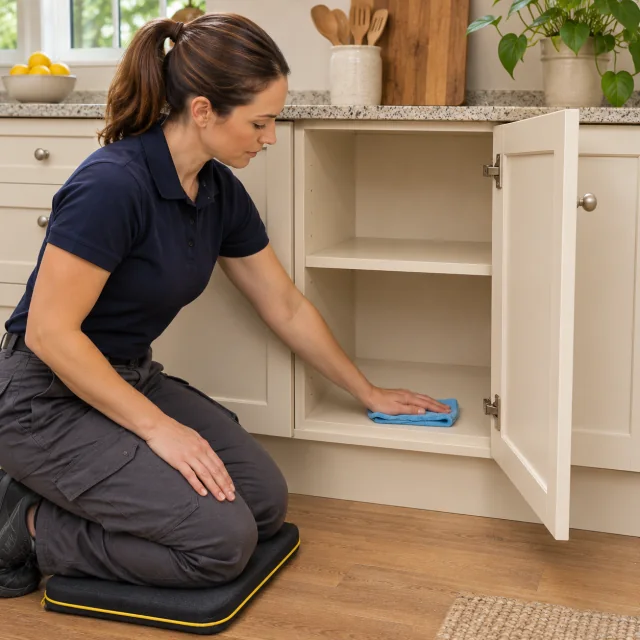
- Cupboard interiors: remove food, dishes and loose items before arrival if empty-interior cleaning is agreed. Do not leave the team to guess where belongings should go.
- Windows: clear the sill and access route; tell us about damaged handles, screens or components that must not be removed.
- Appliances: confirm safe preparation, including whether an oven must be cool or a fridge emptied. Do not disconnect or move heavy appliances without an agreed plan.
- Floors and walls: clear small loose items and supply finish-care information for new materials. Agree separately who moves large furniture.
- Final review: keep the task list available and check the included details, such as tracks and cupboard interiors, before putting belongings back.
If movers need to enter at a fixed time, tell us before agreeing the cleaning date. Avoid booking them at the exact estimated finish. Ask whether the work should happen on an earlier day, or whether a staged plan is realistic. There is no single buffer that suits every property.
“Cleaning finished” and “ready to use” may be different times.
Before cleaners leave, agree what can happen next. A surface may still need to dry, or an agreed removable component may need to be refitted before use. Ask:
- Which rooms and surfaces are ready now? Identify any area that should remain unused until the team’s stated conditions are met.
- When can belongings or furniture go back? Confirm this for cleaned cupboards, floors and other affected surfaces instead of using the team’s departure time as the signal.
- Is anything still drying or awaiting refitting? Name the item, the next step and who is responsible for it.
- What remains unresolved? Review any missed agreed task, persistent mark or excluded work before the next person arrives.
Drying and use instructions depend on the surface and treatment. Ask for the relevant guidance rather than assuming one waiting period applies to the whole home.
Your pre-booking checklist
Use these quick status checks to see what is confirmed and what still needs a conversation.
These boxes are a personal planning aid. They do not submit a booking or save your answers.
What if the work takes longer than expected?
For the agreed scope of work, we keep the quoted price when the combined hours worked by all cleaners run no more than 30% over the plan. We measure this against total cleaner-hours, not just the length of the visit. For example, four cleaners working eight hours represents 32 cleaner-hours.
If the agreed work is expected to exceed that allowance, or another day may be needed, we discuss the next step with the owner. Extra tasks requested during the visit need a separate discussion about the work, price and timing.
If your access deadline is fixed, agree how additional time would be handled before booking. Keep the expected handover and the quoted terms clear; neither should be left to assumption. Our deep-cleaning cost guide explains how the agreed work affects the quote.